
In 1977, the United States Mint produced one-cent coins featuring the image of Abraham Lincoln using a traditional bronze alloy.
Copper makes up 95% of the metal composition, supplemented by a 5% mixture of tin and zinc.
Mass measurements for a standard specimen amount to 3.11 grams, having a weight tolerance of 0.13 grams.
A plain edge lacking any reeding characterizes the coin's diameter of 19.05 mm.
Facilities in Philadelphia (no mint mark), Denver (D), and San Francisco (S) handled the minting operations.
Mintage figures in Philadelphia reached 4,469,930,000 pieces, while Denver produced 4,195,939,100 coins.
Collector sets required 3,251,152 specimens manufactured in Proof quality by the San Francisco facility, usually with a high 1977 penny value.

High coin availability in circulation decades later stems from a total output exceeding 8.6 billion units.
Grade | 1977 (P) RD ($) | 1977-D RD ($) | 1977-S Proof ($) |
MS63 | 0.20 – 0.50 | 0.20 – 0.50 | — |
MS65 | 1.00 – 5.00 | 1.00 – 4.00 | 5.00 |
MS66 | 15.00 – 35.00 | 12.00 – 30.00 | 15.00 |
MS67 | 150.00 – 450.00 | 120.00 – 350.00 | 45.00 |
MS68 | 2,500.00+ | 1,800.00+ | 250.00 (PR70) |
High Preservation Grades
1977 specimens in MS68 RD condition represent an exceptional numismatic rarity due to the mass production method.
Numerous contact injuries resulted from coins falling into general bins after minting.
According to the PCGS registry data, the population in the MS68 RD grade for Philadelphia (1977-P) amounts to fewer than 10 units.
Auction results from 2021 show one such specimen realized for 2,640 dollars.
Value growth for MS68 RD coins averaged 7% annually between 2015 and 2023.
Fluctuating within 15% depending on current market supply, prices for coins in MS67 RD condition demonstrate higher volatility.
Minting Errors of the 1977 Issue
Technical failures were recorded in 1977 despite the absence of major varieties like a prominent Double Die.
Off-Center Strike
Partial absence of the design results from the displacement of the planchet relative to the die.
Valued at 5–12 dollars, 1977 coins with a 10% offset remain common.
The specimen's value increases to 100–150 dollars upon a 50% offset maintaining a full date.
Losing the date due to strong displacement reduces the coin's liquidity by 45–55%.
Die Cracks and Cuds
Raised lines on the coin surfaces appeared following the wear of steel dies.
Occurring less frequently than on early 1980s issues, large "Cuds" (metal protrusions at the rim) remain scarce on 1977 cents.
Market prices for a medium-sized "Cud" vary from 40 to 75 dollars.
Clipped Planchet
Incorrect metal strip feeding into the blanking press leads to this specific defect.
Valued at 15–35 dollars, a certified 1977 cent with a "curved" clip is a documented error.
Philadelphia vs Denver
Technical minting quality in Denver (1977-D) often surpasses Philadelphia counterparts in detail sharpness.
Preserving the fine lines of Lincoln's hair, Denver dies during this period less frequently underwent excessive polishing.
Copper planchets used in Philadelphia, however, more often demonstrate clean fields without carbon spots.
Remaining higher due to the smaller number of surviving "Red" (RD) samples, the investment attractiveness of 1977-P in the MS67 grade is notable.
Realization prices for 1977-P MS67 RD averaged 380 dollars in 2023, while 1977-D MS67 RD sold for 180–220 dollars.
Population Dynamics and Survivability
Registry data from PCGS over a ten-year period allows for conclusions regarding rarity.
Total number of coins sent for grading: Increased by 22% since 2014.
Percentage of obtaining an MS67+ rating: Amounts to less than 0.5% of the total presented samples.
Number of degraded samples: About 12% of coins previously having RD status transition to the RB category due to oxidation in non-hermetic holders.
Supporting price stability, the annual decrease in the population of coins in ideal "red" color creates a shortage.
Patina and Color Classification
Three main color categories serve to classify 1977 cents.
Red (RD): Retention of more than 95% of the original copper luster serves as a mandatory condition for investment purposes.
Red-Brown (RB): Presence of 5% to 95% red color reduces the value by 70–80% compared to RD.
Brown (BN): Complete surface oxidation characterizes these coins, valued at face value excluding rare errors.
Transition speed from RD to RB depends on storage conditions, amounting to about a 2% color change per year at humidity levels above 50%.
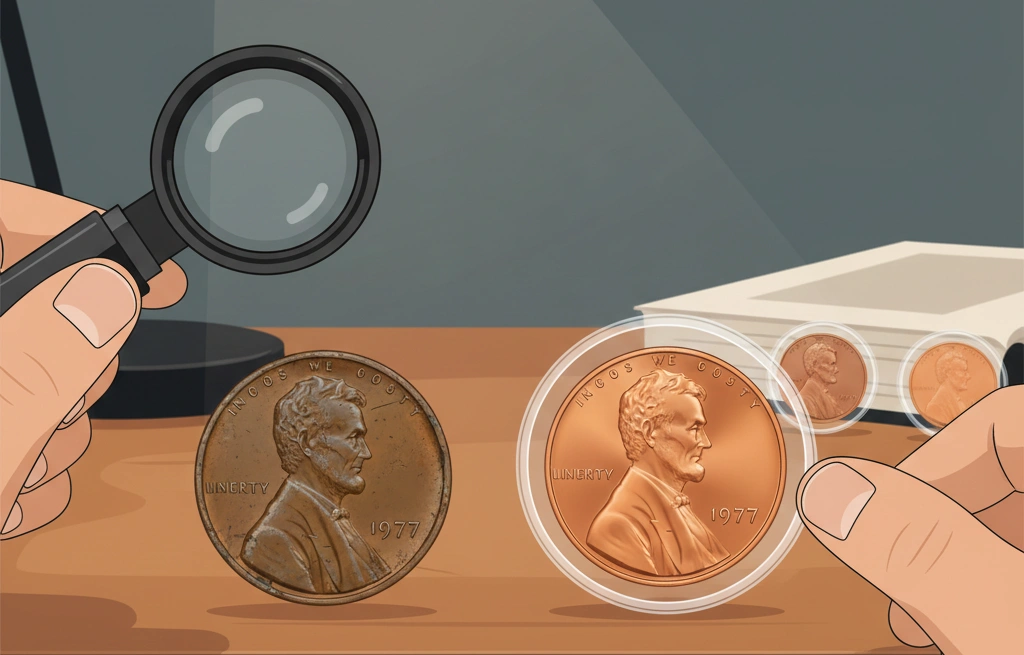
Proof Minting Features (1977-S)
San Francisco issued 1977 Proof coins exclusively for annual sets.
Mirrored fields and frosted reliefs resulted from using polished planchets and dies.
Categorization for most 1977-S coins involves Cameo or Deep Cameo status.
Approximately 400 dollars represents the record price for a 1977-S in PR70 Deep Cameo condition.
Excessive quantities mean specimens in PR69 Deep Cameo are valued at only 12–18 dollars.
A sharp price gap emerges between an ideal coin and a coin having a single microscopic scratch.
Authenticity and Condition
Evaluating a 1977 cent requires following a regulated algorithm.
Weight Check: Values below 2.98 g indicate heavy wear or chemical exposure.
Rim Examination: Die freshness (Early Die State) is indicated by the presence of a "step" on the inner edge.
Cleaning Detection: Zeroing numismatic value, parallel lines under 10x magnification testify to an artificial appearance improvement.
Carbon Spot Analysis: Products of reaction with sulfur, small black dots on copper cannot be removed without surface damage.
Identifying traces of old lacquering used in the 1970s involves utilizing fluorescent lighting.
Market Trends and Forecast for 2025–2030
Historical prices over the last 20 years indicate several mathematical trends.
Market saturation with certified coins suggests price stabilization for MS66 RD.
Provided the current inflation rate continues, the forecast for MS67+ RD price growth amounts to 4.2% annually.
Collector attention shifting to rarer years causes stagnation in the market for 1977 off-center errors.
Liquidity of uncertified "raw" coins remains low, amounting to 0.15 of the price of certified counterparts.
Influence of Uncirculated Mint Sets
Minting operations produced 2,006,128 Uncirculated Mint Sets in 1977.
Serving as the primary source of coins in MS66 and MS67 condition, these sets remain vital for collectors.
Packaging from those years, however, often contains polyvinyl chloride causing a greenish coating on the copper.
Classification as "Environmental Damage" prevents coins with such a coating from receiving professional grading.
Luster restoration through preservatives like MS70 is possible, though it often leaves microscopic pits.
Auction Records
Confirmed top sales from recent years include the following results.
1977-P MS68 RD (PCGS): Sold for $2,640 (Heritage Auctions).
1977-D MS68 RD (PCGS): Sold for $1,980 (eBay/Private sale).
1977-P Double Die Obverse (Minor): Sold for $85 (MS64 RD).
1977-S PR70 DCAM (NGC): Sold for $432 (Stack's Bowers).
High demand for quality material is indicated by a 92% success ratio for 1977 coins in high grades.
Conclusion
The 1977 cent represents an object with a strictly determined value depending on microscopic defects.
Technical difficulty in finding ideal surfaces in late 1970s mass production compensates for an absence of historical significance.
Compared to post-1982 zinc cents, the stability of the 1977 copper alloy makes these coins more durable.
Investors utilizing these analysis methods can minimize risks when acquiring high-category lots.
Confirmed facts indicate the continuation of the accumulation cycle for 1977 coins in MS66+ grades by professional dealers.